Mother Nature sure has been racking up the bonus points lately.
Devastating earthquakes in Haiti, and Chile (and, last week, again, in China) ... Flooding Spring rains here in the USofA ...
And, now, an exploding volcano in Iceland, Eyjafjallajökull, blanketing the better part of a continent with nasty ash;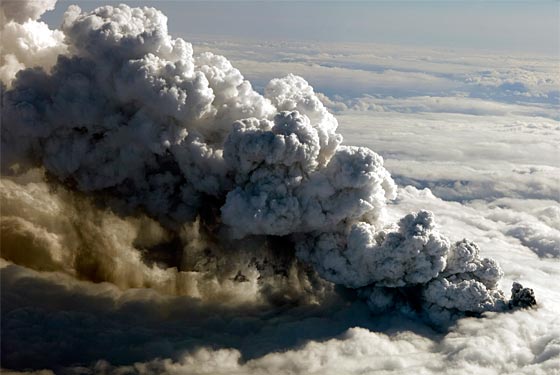
Volcanic ash: Europe flights grounded for third dayMillions of air travellers are stranded as thousands of flights are being cancelled for a third day.
The disruption from the spread of ash would continue into Sunday, European aviation agency Eurocontrol said.
Airlines are losing some £130m ($200m) a day in an unprecedented shutdown of commercial air travel.
"Forecasts suggest that the cloud of volcanic ash will persist and that the impact will continue for at least the next 24 hours," a statement from Eurocontrol said at around 0830 GMT.
[snip]
The UK extended its ban on commercial flights until at least 0700 local time (0600 GMT) on Sunday.
Many other countries, from Ireland to Ukraine, have either closed airspace or shut key airports. In northern France and northern Italy, airports are shut until Monday.
So, we hear you whisper quizzically, what's this volcano in Iceland have anything to do with Louisiana Governor Bobby Jindal?
Does he speak Icelandic?
Well, for one, we're not calling on him (yet), to perform an exorcism on Eyjafjallajökull.
Rather, just another reminder of how, in giving the PartyofNoican Rebuttal to President Obama's first SOTU address, Jindal pooh-pahhed funding of volcano monitoring;Jindal, among other distortions, dissed the monitoring of volcanos;
While some of the projects in the bill make sense, their legislation is larded with wasteful spending. It includes $300 million to buy new cars for the government, $8 billion for high-speed rail projects, such as a "magnetic levitation" line from Las Vegas to Disneyland, and $140 million for something called "volcano monitoring." Instead of monitoring volcanoes, what Congress should be monitoring is the eruption of spending in Washington, D.C
For the want of a talking point ...
It was only delicious irony, just less then two-months later, Alaska's Mount Redoubt erupted.
News tonight has that scientists don't really know how much longer Eyjafjallajökull is going to spew the heavy-duty ash - could be days, weeks, or, even months.
I don't believe it has happened yet, but if this does drag on, you can plan that some Right Wing Freak Show Flying Monkey, Teabagger, or Faux News will find a way to blame this on Obama, the Democrats, mock Climate Change or, incredulously, tie it in to how the government is taking over healthcare (we can, perhaps, count on our seminal Ignorant Dolt, Michele Bachmann for that)
Bonus Links
NYT: Air Travel Crisis Deepens as Europe Fears Wider Impact
Ron Beasley: Volcanoes and History
The Lede: Video of Volcano Spewing More Ash
The Lede: One Word: Eyjafjallajokull
Too Perfect! ... Jindal Jabberwocky II
Saturday, April 17, 2010
Paging Bobby Jindal!


Friday, September 11, 2009
Rebecca Solnit: How 9/11 Should Be Remembered
It was nearly two-years ago that we highlighted Rebecca Solnit here on The Garlic, and, on this specific day, we are compelled to have her return.
Over on TomDispatch, Ms. Solnit has a fantastic post, an excerpt from her new book, that should be read by one-and-all;
How 9/11 Should Be Remembered - The Extraordinary Achievements of Ordinary PeopleFor this eighth anniversary of that terrible day, the first post-Bush-era anniversary, let's remember what actually happened:
When the planes became missiles and the towers became torches and then shards and clouds of dust, many were afraid, but few if any panicked, other than the President who was far away from danger. The military failed to respond promptly, even though the Pentagon itself was attacked, and the only direct resistance that day came from inside Flight 93, which went down in a field in Pennsylvania on its way to Washington.
[snip]
We failed, however, when we let our own government and media do what that small band from the other side of the Earth could not. Some of us failed, that is, for there were many kinds of response, and some became more radical, more committed, more educated. Mark Fichtel, the president of the New York Coffee, Sugar, and Cocoa Exchange, who scraped his knees badly that morning of September 11th when he was knocked over in a fleeing crowd, was helped to his feet by "a little old lady." He nonetheless had his Exchange up and running the next day, and six months later quit his job, began studying Islam, and then teaching about it.
[snip]
Far more people could have died on September 11th if New Yorkers had not remained calm, had not helped each other out of the endangered buildings and the devastated area, had not reached out to pull people from the collapsing buildings and the dust cloud. The population of the towers was lower than usual that morning, because it was an election day and many were voting before heading to work; it seems emblematic that so many were spared because they were exercising their democratic powers. Others exercised their empathy and altruism. In the evacuation of the towers, John Abruzzo, a paraplegic accountant, was carried down 69 flights of stairs by his coworkers.
[snip]
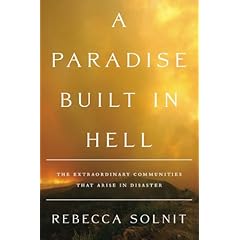
Many New Yorkers that day committed similar feats of solidarity at great risk. In fact, in all the hundreds of oral histories I read and the many interviews I conducted to research my book, "A Paradise Built in Hell: The Extraordinary Communities That Arise in Disaster", I could find no one saying he or she was abandoned or attacked in that great exodus. People were frightened and moving fast, but not in a panic. Careful research has led disaster sociologists to the discovery -- one of their many counter-stereotypical conclusions -- that panic is a vanishingly rare phenomenon in disasters, part of an elaborate mythology of our weakness
[snip]
New Yorkers triumphed on that day eight years ago. They triumphed in calm, in strength, in generosity, in improvisation, in kindness. Nor was this something specific to that time or place: San Franciscans during the great earthquake of 1906, Londoners during the Blitz in World War II, the great majority of New Orleanians after Hurricane Katrina hit, in fact most people in most disasters in most places have behaved with just this sort of grace and dignity.
[snip]
After the 9/11 storm struck, the affected civilians in New York were seen as victims; after Katrina, those in New Orleans were portrayed as brutes. In both cities, the great majority of affected people were actually neither helpless nor savage; they were something else -- they were citizens, if by that word we mean civic engagement rather than citizenship status. In both places ordinary people were extraordinarily resourceful, generous, and kind, as were some police officers, firefighters, rescue workers, and a very few politicians. In both cases, the majority of politicians led us astray. All I would have wanted in that September moment, though, was politicians who stayed out of the way, and people who were more suspicious of the news and the newsmakers.
[snip]
The dead must be remembered, but the living are the monument, the living who coexist in peace in ordinary times and who save one another in extraordinary times. Civil society triumphed that morning in full glory. Look at it: remember that this is who we were and can be.
September 11th may never become the holiday, or, day-of-remembrance, it should be, chiefly due to the dwarf, finks, phonies and frauds of The Bush Grindhouse, and all the cronies - the Flying Monkeys of the Right Wing Freak Show, and the cheerleading Corporate Media - how they exploited the tragedy for the masturbation of their own warped ideology (ironically, killing hundreds-of-thousands more).
It takes ordinary people - like Rebecca Solnit, and many, many others - to put it in the right perspective.
Go read Rebecca Solnit's "How 9/11 Should Be Remembered - The Extraordinary Achievements of Ordinary People", and leave a comment, if you were able to keep your eyes dry while absorbing it.
And, you can go here to purchase her book, "A Paradise Built in Hell: The Extraordinary Communities That Arise in Disaster"