He was one of the most prolific trumpet players in Jazz, and, man, I can't count the number of albums I have that he is part of, be it Basie, Quincy Jones, Gerald Wilson, Thad Jones-Mel Lewis, and others.
It was sad to learn today that Snooky Young passed away, at the age of 92.
Most of the obits herald his long stay in the 'Tonight Show' band (which was stocked with some major players), but Snooky was much more than that.
As lead trumpeter in the ensembles of Count Basie, Lionel Hampton, Benny Goodman and many others, Mr. Young had one of the more challenging tasks in jazz. The lead trumpeter is in effect the concertmaster of a big band, establishing the way an arrangement is phrased and interpreted not just by the trumpet section but by the entire ensemble. He must also be comfortable in all registers, especially the highest ones. Mr. Young was widely regarded by his peers as one of the great lead trumpeters.
He performed on movie soundtracks, including “The Color Purple,” “New York, New York” and “Blazing Saddles” and appeared as a sideman on albums by artists as diverse as B.B. King, Quincy Jones and the rock group the Band.
Mr. Young, who recorded only three albums as a leader of small groups, preferred the brassy, roaring sound of a big band. His specialty was in playing first trumpet, or lead, in a big band. Although he didn’t solo as much as other players in the section, he usually played a tune’s melody and, with his soaring high notes, formed the core of the band’s trumpet sound.
“Snooky is one of the world’s all-time great trumpet players,” saxophonist Bob Cooper told the Los Angeles Times in 1992. “I can always feel it in the sax section when he’s playing — his time, his interpretation of the material, his sound.”
R.I.P. Snooky Young
Here's some of the music, and go out and explore on your own.
Once, when living in Los Angeles, and the 24-hour jazz radio station, KKGO, as I awoke, was playing a very long set of Willie Bobo's music, and I knew that had to mean that Willie, who had been ill, passed away.
So, the night-before-last, Jazz With Bob Parlocha comes on at midnight with a set of James Moody's music and that eerie feeling hung in the air, soon confirmed by Parlocha that James Moody, the Sax and Reed player extraordinaire, had passed away, at age 85.
I was fortunate to have seen Moody perform, live, numerous times, and it was always a treat, be it his own band, or if he was a sideman in someone elses.
It was reported that Mr. Moody had pancreatic cancer and chose not to go through the cumbersome treatment (radiation or chemo) and that sounds like how he lived his life, taking things head on, learning as he went along, always trying to be better.
The song he sang most often had a memorable name and an unusual history. Based on the harmonic structure of “I’m in the Mood for Love,” it began life as an instrumental when Mr. Moody recorded it in Stockholm in 1949, improvising an entirely new melody on a borrowed alto saxophone. Released as “I’m in the Mood for Love” (and credited to that song’s writers) even though his rendition bore only the faintest resemblance to the original tune, it was a modest hit for Mr. Moody in 1951. It became a much bigger hit shortly afterward when the singer Eddie Jefferson wrote lyrics to Mr. Moody’s improvisation and another singer, King Pleasure, recorded it as “Moody’s Mood for Love.”
“Moody’s Mood for Love” (which begins with the memorable lyric “There I go, there I go, there I go, there I go ...”) became a jazz and pop standard, recorded by Aretha Franklin, George Benson, Van Morrison, Amy Winehouse and others. And it was a staple of Mr. Moody’s concert and nightclub performances as sung by Mr. Jefferson, who was a member of his band for many years. Mr. Jefferson was shot to death in 1979; when Mr. Moody, who was in the middle of a long hiatus from jazz at the time, resumed his career a few years later, he began singing the song himself. He never stopped.
Our In Box, this morning, carried the sad news, of the death of the great Jazz pianist, Hank Jones, at age 91, in the Bronx, New York.
We were lucky to have seen Hank Jones perform a handful of times, and it was always tremendous, a consummate professional, you left a Hank Jones show satisfied, and in awe, of his, seemingly, effortlessly manner of employing his gift.
Praised for the feather-soft precision of his touch, Jones was equally adept at unleashing the piano's full, orchestral gamut of sounds. Rhythmic lift and propulsive swing were inherent to his playing, whether performing as an accompanist or in a solo setting. And his deep understanding of harmony was the foundation for a skilled mastery of the diverse material in the Great American Songbook.
[snip]
As recently as 2008, Los Angeles jazz audiences heard Jones in a pair of Southland performances — in a trio concert at UCLA and a 90th birthday celebration at the Hollywood Bowl — clearly illustrating that he had long ago ascended to the lofty level he described.
[snip]
Over the next 15 years he was a first-call accompanist for virtually every major jazz artist of the time, backing Fitzgerald, Davis, Young, Adderley, Hawkins, Holiday and Ben Webster, among others. A three-year run with Norman Granz's Jazz at the Philharmonic from 1947 to 1950 matched him with Roy Eldridge, Max Roach and Parker. In 1955, with the release of "The Trio of Hank Jones" (with Wendell Marshall and Kenny Clarke), he began a six-decade sequence of supplementing his busy sideman schedule with recordings under his own name.
Look through your collection of Jazz records (okay, CD's, or downloads), and you may be surprised on just how many that Jones is manning the piano.
Mr. Jones spent much of his career in the background. For three and a half decades he was primarily a sideman, most notably with Ella Fitzgerald; for much of that time he also worked as a studio musician on radio and television.
His fellow musicians admired his imagination, his versatility and his distinctive style, which blended the urbanity and rhythmic drive of the Harlem stride pianists, the dexterity of Art Tatum and the harmonic daring of bebop. (The pianist, composer and conductor André Previn once called Mr. Jones his favorite pianist, “regardless of idiom.”)
And, as to that "effortless" way of playing?
“I think the way you practice has a lot to do with it,” he explained. “If you practice scales religiously and practice each note firmly with equal strength, certainly you’ll develop a certain smoothness. I used to practice a lot. I still do when I’m at home.” Mr. Jones was 78 years old at the time.
It was sad to discover, via multiple posts, the passing of actress, and Jazz singer, Lena Horne.
I have a handful of her albums (well, now, CD's) and she had a lovely voice, you knew, from the first note or two, that it was Lena Horne singing, so soft, or sultry.
Ms. Horne was stuffed into one “all-star” musical after another — “Thousands Cheer” (1943), “Broadway Rhythm” (1944), “Two Girls and a Sailor” (1944), “Ziegfeld Follies” (1946), “Words and Music” (1948) — to sing a song or two that could easily be snipped from the movie when it played in the South, where the idea of an African-American performer in anything but a subservient role in a movie with an otherwise all-white cast was unthinkable.
[snip]
Touring Army camps for the U.S.O., Ms. Horne was outspoken in her criticism of the way black soldiers were treated. “So the U.S.O. got mad,” she recalled. “And they said, ‘You’re not going to be allowed to go anyplace anymore under our auspices.’ So from then on I was labeled a bad little Red girl.”
Ms. Horne later claimed that for this and other reasons, including her friendship with leftists like Paul Robeson and W.E.B. DuBois, she was blacklisted and “unable to do films or television for the next seven years” after her tenure with MGM ended in 1950.
[snip]
Ms. Horne’s voice was not particularly powerful, but it was extremely expressive. She reached her listeners emotionally by acting as well as singing the romantic standards like “The Man I Love” and “Moon River” that dominated her repertory. The person she always credited as her main influence was not another singer but a pianist and composer, Duke Ellington’s longtime associate Billy Strayhorn.
“I wasn’t born a singer,” she told Strayhorn’s biographer, David Hajdu. “I had to learn a lot. Billy rehearsed me. He stretched me vocally.” Strayhorn occasionally worked as her accompanist and, she said, “taught me the basics of music, because I didn’t know anything.”
[snip]
Looking back at the age of 80, Ms. Horne said: “My identity is very clear to me now. I am a black woman. I’m free. I no longer have to be a ‘credit.’ I don’t have to be a symbol to anybody; I don’t have to be a first to anybody. I don’t have to be an imitation of a white woman that Hollywood sort of hoped I’d become. I’m me, and I’m like nobody else.”
While that be the standard, boiler-plate obit, we found a few people that came to Lena Horne via other routes.
I know why there's no sun up in the sky and that's because the world has lost the irreplaceable Lena Horne at the age of 92. The actress/singer who helped to break down racial barriers by becoming the first African-American performer to receive a major Hollywood studio contract passed away Sunday night in a Manhattan hospital.
[snip]
The bulk of her career was spent taking that sultry voice to concert halls or appearing as herself in other venues such as That's Entertainment III and sitcoms such as A Different World, The Cosby Show and a particularly memorable Sanford & Son, where Fred tricked her into coming to his house claiming that Lamont was his young, terminally ill child.
I know the exact moment I saw Lena Horne for the first time. I was 11, and she made a guest appearance on "The Cosby Show," as herself, in an episode where Claire (Phylicia Rashad) took Cliff (Bill Cosby) to see her perform for his birthday. I remember thinking how beautiful and glamorous she was, and falling utterly in love with her voice, which has remained to this day one of my absolute favorites—totally recognizable, totally unmistakable, totally butter.
That hits it, "totally butter."
And, while a bevy of people posted her signature tune, "Stormy Weather" (Dave Itzkoff, over on the NYT Artsbeat, additionally posted a nice one, of Lena Horne and Kermit the Frog singing "It Ain't Easy Being Green"), we took the nod from our friend Dee Dee Gordon, who went with, a classic, a Jazz standard, written by Michael Legrand, for "Les Parapluies de Cherbourg" (which also happens to be one of my all-time favorite tunes).
No, we won't be a dolt, and leave you hanging, sitting there, reading this, thinking "Okay, what President would have been 100-years-old today?"
This guy was never elected.
Check that.
He was, perhaps, unanimously acclaimed as the coolest cat on the planet.
The original hipster.
The Prez we speak of, and herald today, is Jazz giant Lester Young.
Many of my friends know, one of my biggest laments in life is that I don’t wake up in the morning with the ability to play the tenor saxophone like Lester Young (if I could play it at all, that is).
Man, Prez just beat it to death ... A monster player, paid his dues in the Basie Band, and swung with the best of them.
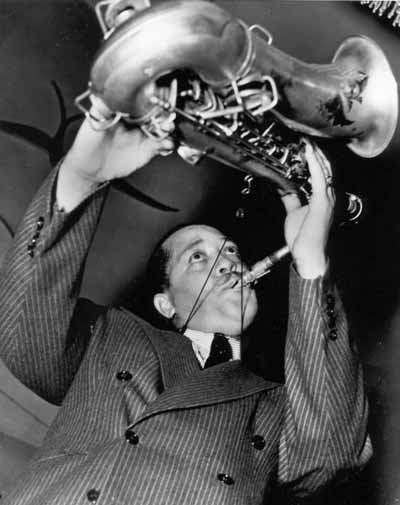
Lester “Prez” Young was one of the giants of the tenor saxophone. He was the greatest improviser between Coleman Hawkins and Louis Armstrong of the 1920s and Charlie Parker in the 1940s. From the beginning, he set out to be different: He had his own lingo; In the Forties, he grew his hair out. The other tenor players held their saxophones upright in front of them, so Young held his out to the side, kind of like a flute (see picture above). Then, there was the way he played: Hawkins played around harmonic runs. He played flurries of notes and had a HUGE tone that the other tenor players of the day emulated. Young used a softer tone that resulted In a soft, light sound (if you didn't know better, you would think the two were playing different instruments). Young used less notes and slurred notes together, creating more melodic solos. He played the ordinary in an extraordinary way, using a lot of subtleties to produce music that Billie Holiday said flips you out of your seat with surprise.
And, lest you think that it is only our opinion about Lester Young being the "coolest cat on the planet";
Like many of Young’s phrases—musical and verbal—the comment was both deft and shrouded. He was known for speaking a private language, some of which has entered the American lexicon. The expression “that’s cool” was probably coined by him, as were “bread” (for money), “You dig?” and such colorful sayings as “I feel a draft”—code for prejudice and hostility in the air. He also wore sunglasses in nightclubs, sported a crushed black porkpie hat and tilted his saxophone at a high angle “like a canoeist about to plunge his paddle into the water,” as the New Yorker’s Whitney Balliett put it. Rolling Stone later pronounced Prez “quite likely the hippest dude that ever lived.”
Young was viewed as an eccentric by those he chose to exclude from his circle (those he did not trust). He did so by creating his own language that his friends could understand, that might baffle outsiders. Those on the outside viewed it as a rococo and often inscrutable personal slang, famously referring to a narcotics detective or policeman as a "Bob Crosby" (referring to Bob and Bing Crosby if multiple police officers were present), a rehearsal as a "molly trolley", and an instrumentalist's keys or fingers as his "people". He dressed distinctively, especially in his trademark pork pie hat. When he played saxophone, particularly in his younger days, he would sometimes hold the horn off to the right side at a near-horizontal angle, like a flute. Joop Visser believes that it was Lester's residence in the stuffy Reno Club with the Count Basie Band that caused this idiosyncrasy, as by holding it that way it was the only way Lester could keep his tenor sax from knocking into someone else's instrument. He is considered by many to be an early hipster, predating Slim Gaillard and Dizzy Gillespie.
Since the days of Joe "King" Oliver, jazz has bestowed lofty titles upon its ace practitioners. Bessie Smith graduated from "Queen of the Blues" to "Empress of the Blues," Benny Goodman was proclaimed "King of Swing", there was a "Duke" Ellington, a "Count" Basie, and Lester Young was dubbed Prez (short for president, a title given to him by Billie Holiday). "We called my mother 'the Duchess,'" Holiday said in a 1959 interview, "so he [Lester Young] named me 'Lady Day' and I called him 'Prez'--we were the royal family."[3] It has been suggested that Young was called "Prez" long before meeting her, but there is no evidence of that.
If I had a time machine, probably, the first place I would go back to, is the era of Lester Young.
J. Thomas Duffy created and lauched 'The Garlic in 2005.
Mr. Duffy is an accomplished writer, with experience as a newspaper reporter, radio writer, comedy and stand-up writer, the author of three children's books (unpublished, so far) and, and, through a good number of his writing experience, actually received payment for it.
Mr. Duffy is also a Contributing Editor on the blog, 'The Reaction' and a Contributing Writer to the blog 'The Moderate Voice.
In his spare time, Mr. Duffy likes to promulgate that is actually the dog salivating that caused Pavlov to ring the bell.