Showing posts with label Jazz History. Show all posts

Friday, May 20, 2011

R.I.P Snooky Young

He was one of the most prolific trumpet players in Jazz, and, man, I can't count the number of albums I have that he is part of, be it Basie, Quincy Jones, Gerald Wilson, Thad Jones-Mel Lewis, and others.


It was sad to learn today that Snooky Young passed away, at the age of 92.


Most of the obits herald his long stay in the 'Tonight Show' band (which was stocked with some major players), but Snooky was much more than that.


From Peter Keepnews;

As lead trumpeter in the ensembles of Count Basie, Lionel Hampton, Benny Goodman and many others, Mr. Young had one of the more challenging tasks in jazz. The lead trumpeter is in effect the concertmaster of a big band, establishing the way an arrangement is phrased and interpreted not just by the trumpet section but by the entire ensemble. He must also be comfortable in all registers, especially the highest ones. Mr. Young was widely regarded by his peers as one of the great lead trumpeters.

And Matt Schudel;
He performed on movie soundtracks, including “The Color Purple,” “New York, New York” and “Blazing Saddles” and appeared as a sideman on albums by artists as diverse as B.B. King, Quincy Jones and the rock group the Band.


Mr. Young, who recorded only three albums as a leader of small groups, preferred the brassy, roaring sound of a big band. His specialty was in playing first trumpet, or lead, in a big band. Although he didn’t solo as much as other players in the section, he usually played a tune’s melody and, with his soaring high notes, formed the core of the band’s trumpet sound.


“Snooky is one of the world’s all-time great trumpet players,” saxophonist Bob Cooper told the Los Angeles Times in 1992. “I can always feel it in the sax section when he’s playing — his time, his interpretation of the material, his sound.”

R.I.P. Snooky Young


Here's some of the music, and go out and explore on your own.


Count Basie Orchestra - Li'l Darlin'


Flying Home


Doc Severinsen, Snooky Young, Tommy Newsom, and the NBC Orchestra play the One O'Clock & Bugle Call Rag ... Tonight Show Band


Tuesday, February 15, 2011

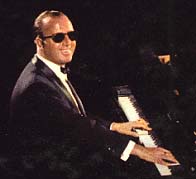
Jazz Legend George Shearing Dies

I heard this on the radio this morning, and it shadowed the beginning of the day in sadness;

George Shearing dies aged 91

Announcing the death due to heart failure at Shearing's home in Manhattan, his agent, Dale Sheets, said: "He was a totally one of a kind performer. It was something wonderful to see, to watch him work."


I had the good fortune to catch Shearing a few times, both, in club, and festival, settings, and it was always a delicious treat, the crowd hushing to the point you could hear a pin drop, settling in for the unique Shearing sound.

Peter Keepnews explains;

The Shearing sound — which had the harmonic complexity of bebop but eschewed bebop’s ferocious energy — was built on the unusual instrumentation of vibraphone, guitar, piano, bass and drums. To get the “full block sound” he wanted, he had the vibraphone double what his right hand played and the guitar double the left. That sound came to represent the essence of sophisticated hip for countless listeners worldwide who preferred their jazz on the gentle side.

[snip]

By his own estimate Mr. Shearing wrote about 300 tunes, of which he liked to joke that roughly 295 were completely unknown.

He nevertheless contributed at least one bona fide standard to the jazz repertory: “Lullaby of Birdland,” written in 1952 and adopted as the theme song of the world-famous New York nightclub where he frequently performed. Both as an instrumental and with words by George David Weiss, it has been recorded by everyone from Ella Fitzgerald to Bill Haley and His Comets, who improbably cut a version called “Lullaby of Birdland Twist” in 1962


And who else remembers the television commercial, featuring Ray Charles (for a Pioneer LaserDisc), delivering the punchline "I liked it so much, I got one for my friend, George Shearing", the joke being Shearing is also blind.

RIP George Shearing, it was great having you around.


George Shearing - Lullaby of Birdland


And here's a personal favorite;

GEORGE SHEARING playing IT NEVER ENTERED MY MIND


Tuesday, May 18, 2010

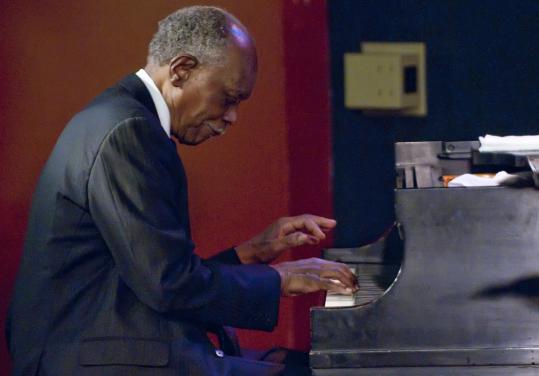
Hank Jones at 91, Legenday Jazz Pianist/Composer/Grammy Winner

Our In Box, this morning, carried the sad news, of the death of the great Jazz pianist, Hank Jones, at age 91, in the Bronx, New York.


We were lucky to have seen Hank Jones perform a handful of times, and it was always tremendous, a consummate professional, you left a Hank Jones show satisfied, and in awe, of his, seemingly, effortlessly manner of employing his gift.

From Dan Heckman, LA Times;

Hank Jones, jazz pianist who spanned styles and generations, dies at 91

Praised for the feather-soft precision of his touch, Jones was equally adept at unleashing the piano's full, orchestral gamut of sounds. Rhythmic lift and propulsive swing were inherent to his playing, whether performing as an accompanist or in a solo setting. And his deep understanding of harmony was the foundation for a skilled mastery of the diverse material in the Great American Songbook.

[snip]

As recently as 2008, Los Angeles jazz audiences heard Jones in a pair of Southland performances — in a trio concert at UCLA and a 90th birthday celebration at the Hollywood Bowl — clearly illustrating that he had long ago ascended to the lofty level he described.

[snip]

Over the next 15 years he was a first-call accompanist for virtually every major jazz artist of the time, backing Fitzgerald, Davis, Young, Adderley, Hawkins, Holiday and Ben Webster, among others. A three-year run with Norman Granz's Jazz at the Philharmonic from 1947 to 1950 matched him with Roy Eldridge, Max Roach and Parker. In 1955, with the release of "The Trio of Hank Jones" (with Wendell Marshall and Kenny Clarke), he began a six-decade sequence of supplementing his busy sideman schedule with recordings under his own name.

Look through your collection of Jazz records (okay, CD's, or downloads), and you may be surprised on just how many that Jones is manning the piano.

Peter Keepnews, NYT;
Mr. Jones spent much of his career in the background. For three and a half decades he was primarily a sideman, most notably with Ella Fitzgerald; for much of that time he also worked as a studio musician on radio and television.

His fellow musicians admired his imagination, his versatility and his distinctive style, which blended the urbanity and rhythmic drive of the Harlem stride pianists, the dexterity of Art Tatum and the harmonic daring of bebop. (The pianist, composer and conductor André Previn once called Mr. Jones his favorite pianist, “regardless of idiom.”)
And, as to that "effortless" way of playing?
“I think the way you practice has a lot to do with it,” he explained. “If you practice scales religiously and practice each note firmly with equal strength, certainly you’ll develop a certain smoothness. I used to practice a lot. I still do when I’m at home.” Mr. Jones was 78 years old at the time.


BBC: Hank Jones obituary


RIP Hank Jones, but do it as you always have - keep on swingin'!

Here's a few tunes you can check out.

Hank Jones - On Green Dolphin Street


Hank Jones Trio 1979 - Bluesette


Hank Jones: Willow Weep For Me


Monday, May 10, 2010

Stormy Weather, Indeed ... RIP Lena Horne

It was sad to discover, via multiple posts, the passing of actress, and Jazz singer, Lena Horne.

I have a handful of her albums (well, now, CD's) and she had a lovely voice, you knew, from the first note or two, that it was Lena Horne singing, so soft, or sultry.


Lena Horne, Singer and Actress, Dies at 92

Ms. Horne was stuffed into one “all-star” musical after another — “Thousands Cheer” (1943), “Broadway Rhythm” (1944), “Two Girls and a Sailor” (1944), “Ziegfeld Follies” (1946), “Words and Music” (1948) — to sing a song or two that could easily be snipped from the movie when it played in the South, where the idea of an African-American performer in anything but a subservient role in a movie with an otherwise all-white cast was unthinkable.

[snip]

Touring Army camps for the U.S.O., Ms. Horne was outspoken in her criticism of the way black soldiers were treated. “So the U.S.O. got mad,” she recalled. “And they said, ‘You’re not going to be allowed to go anyplace anymore under our auspices.’ So from then on I was labeled a bad little Red girl.”

Ms. Horne later claimed that for this and other reasons, including her friendship with leftists like Paul Robeson and W.E.B. DuBois, she was blacklisted and “unable to do films or television for the next seven years” after her tenure with MGM ended in 1950.

[snip]

Ms. Horne’s voice was not particularly powerful, but it was extremely expressive. She reached her listeners emotionally by acting as well as singing the romantic standards like “The Man I Love” and “Moon River” that dominated her repertory. The person she always credited as her main influence was not another singer but a pianist and composer, Duke Ellington’s longtime associate Billy Strayhorn.

“I wasn’t born a singer,” she told Strayhorn’s biographer, David Hajdu. “I had to learn a lot. Billy rehearsed me. He stretched me vocally.” Strayhorn occasionally worked as her accompanist and, she said, “taught me the basics of music, because I didn’t know anything.”

[snip]

Looking back at the age of 80, Ms. Horne said: “My identity is very clear to me now. I am a black woman. I’m free. I no longer have to be a ‘credit.’ I don’t have to be a symbol to anybody; I don’t have to be a first to anybody. I don’t have to be an imitation of a white woman that Hollywood sort of hoped I’d become. I’m me, and I’m like nobody else.”


While that be the standard, boiler-plate obit, we found a few people that came to Lena Horne via other routes.

Like, Edward Copeland;
I know why there's no sun up in the sky and that's because the world has lost the irreplaceable Lena Horne at the age of 92. The actress/singer who helped to break down racial barriers by becoming the first African-American performer to receive a major Hollywood studio contract passed away Sunday night in a Manhattan hospital.

[snip]

The bulk of her career was spent taking that sultry voice to concert halls or appearing as herself in other venues such as That's Entertainment III and sitcoms such as A Different World, The Cosby Show and a particularly memorable Sanford & Son, where Fred tricked her into coming to his house claiming that Lamont was his young, terminally ill child.


Or, Melissa McEwan;
I know the exact moment I saw Lena Horne for the first time. I was 11, and she made a guest appearance on "The Cosby Show," as herself, in an episode where Claire (Phylicia Rashad) took Cliff (Bill Cosby) to see her perform for his birthday. I remember thinking how beautiful and glamorous she was, and falling utterly in love with her voice, which has remained to this day one of my absolute favorites—totally recognizable, totally unmistakable, totally butter.

That hits it, "totally butter."


And, while a bevy of people posted her signature tune, "Stormy Weather" (Dave Itzkoff, over on the NYT Artsbeat, additionally posted a nice one, of Lena Horne and Kermit the Frog singing "It Ain't Easy Being Green"), we took the nod from our friend Dee Dee Gordon, who went with, a classic, a Jazz standard, written by Michael Legrand, for "Les Parapluies de Cherbourg" (which also happens to be one of my all-time favorite tunes).

It's a gem ...

Lena Horne with Gabor Szabo - Watch What Happens (Revised)

Tuesday, March 17, 2009

Nice Little Piece of Jazz History

Well, I don't know about you, but I certainly could enjoy a respite from the cacophony of blowhards, in Day Two of the A.I.G. conflagration, that even, if he were still around, the legendary Red Adair would find it difficult to cap.

Quite a bit of fulminating, by far too many people that are in desperate need of a tailor.

Those on the Obama Team, and in Congress, have been caught with their pants down, and can't say "I'm shocked ... shocked to find gambling going on here ..." fast enough, or often enough, over the Always Incredibly Greedy bonuses.

Go out to Memeorandum for all of that.

We, here, offer you a wonderful oasis to get away from it all, found on Open Salon (to which, The Garlic, has staked out a little piece of turf, primarily, for cross-posting purposes).

Writer Rebecca Clay Haynes has penned "Dropping Bombs with Kenny Clarke", a nice little piece of Jazz history, on the legendary drummer.


Clarke had an incredible arc, of both pre-and-post Bebop, playing with all the cats and giants of the times, a majority of his career spent in Europe.

If you don't recognize the name, singularly, you may know him from the Kenny Clarke-Francy Boland Big Band, a monster group that was a bit under-the-radar, but, certainly, well critically-acclaimed (and they were as tight as Ellington or Basie).

A few snips from Haynes' "Dropping Bombs with Kenny Clarke";

When I taste madeleines, I remember sitting at the feet of the great jazz drummer, Kenny Clarke, in his modest living room in Montreuil-sous-Bois, while his wife, Daisy, plied us with those fluffy scallop shells.

As a starving young journalist, I'm sure I ate more than my fair share.

[Snip]

But the "most enjoyable moment of playing jazz for me was with Dizzy Gillespie," he said. He had known Dizzy since at least 1940 but he said that "the big band he brought to Paris was the most fantastic and stimulating band I had ever played with. It was so advanced, so new, so, ohhh."

[Snip]

Despite his own failing health at the time of our interview, Kenny was still teaching drumming at schools and conservatories in Paris and throughout Europe.

He also played "from time to time" at Le Dreher, a popular jazz venue on the Place Ch âtelet in the heart of Paris. I went to hear him perform in that cramped, smoky subterranean club, several winding sets of stairs down into the ground.
It's a good read, a small window, in a smaller time machine, of a piece of Jazz history.

Go check out "Dropping Bombs with Kenny Clarke"

And, here's a video, of the Kenny Clarke-Francy Boland Big Band, circa 1970